
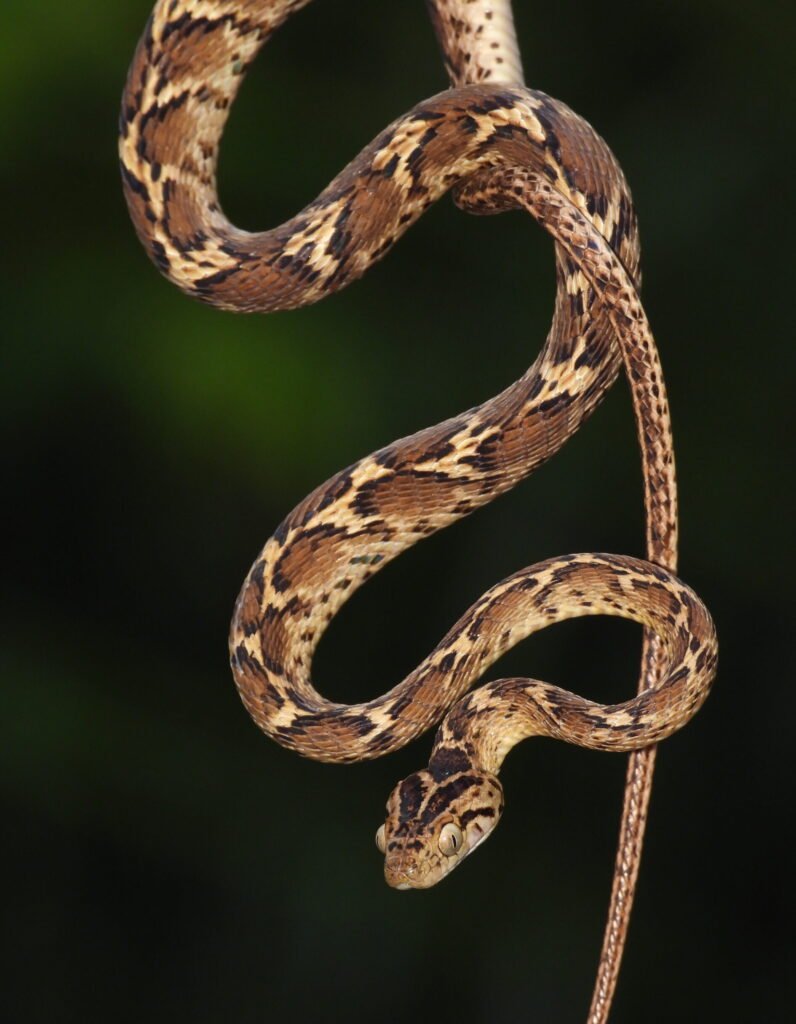
Common Cat Snake
Snake Image Gallery
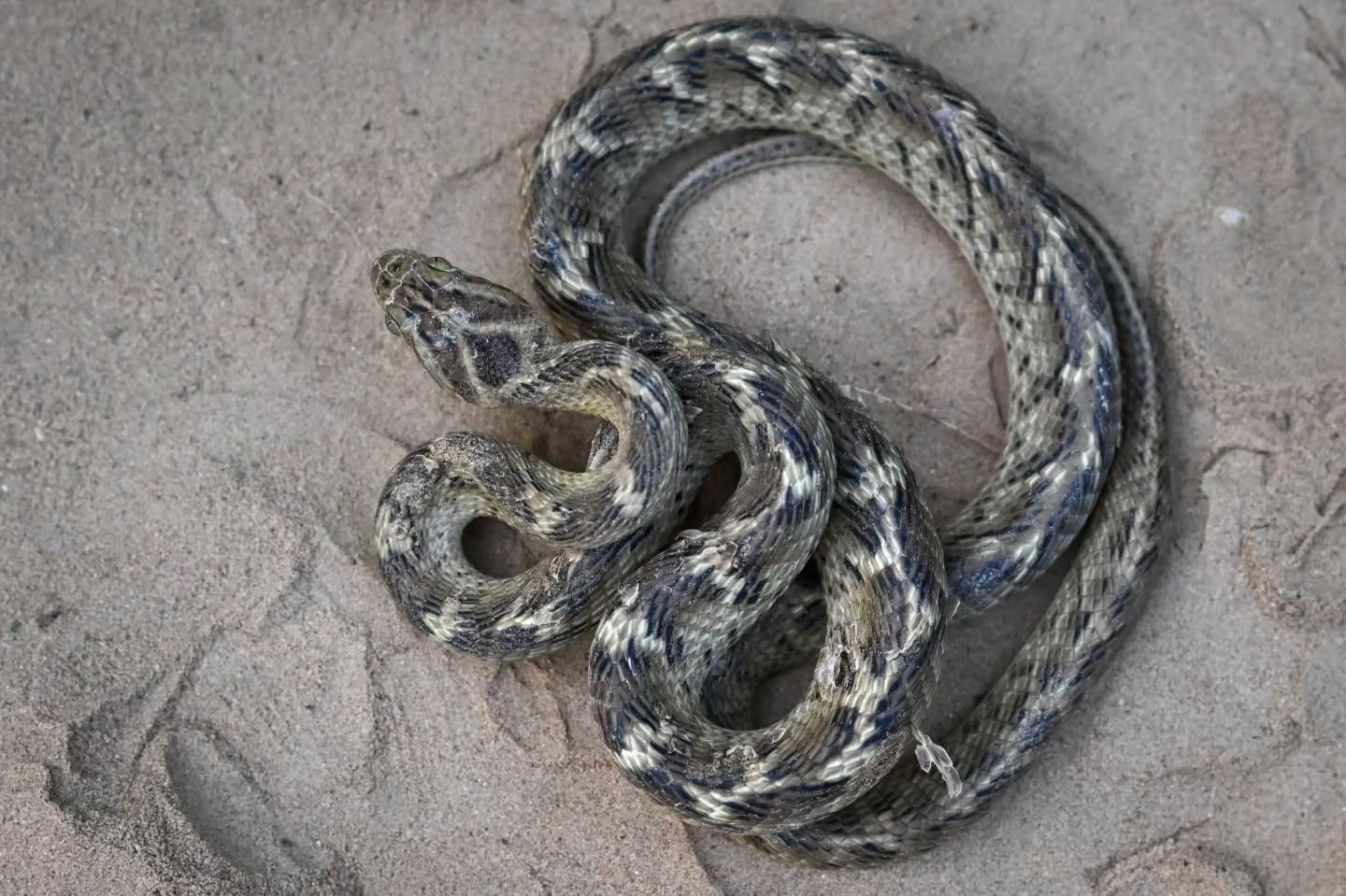
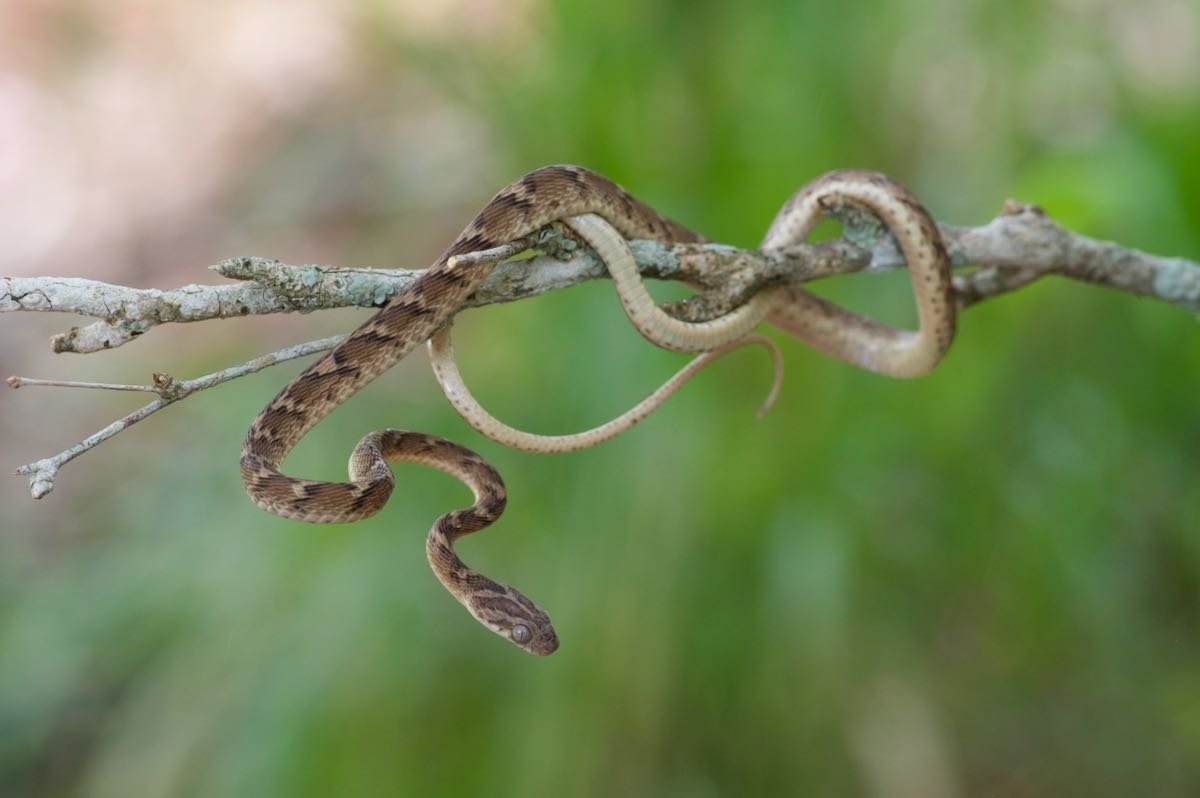
Identification
How to Identify
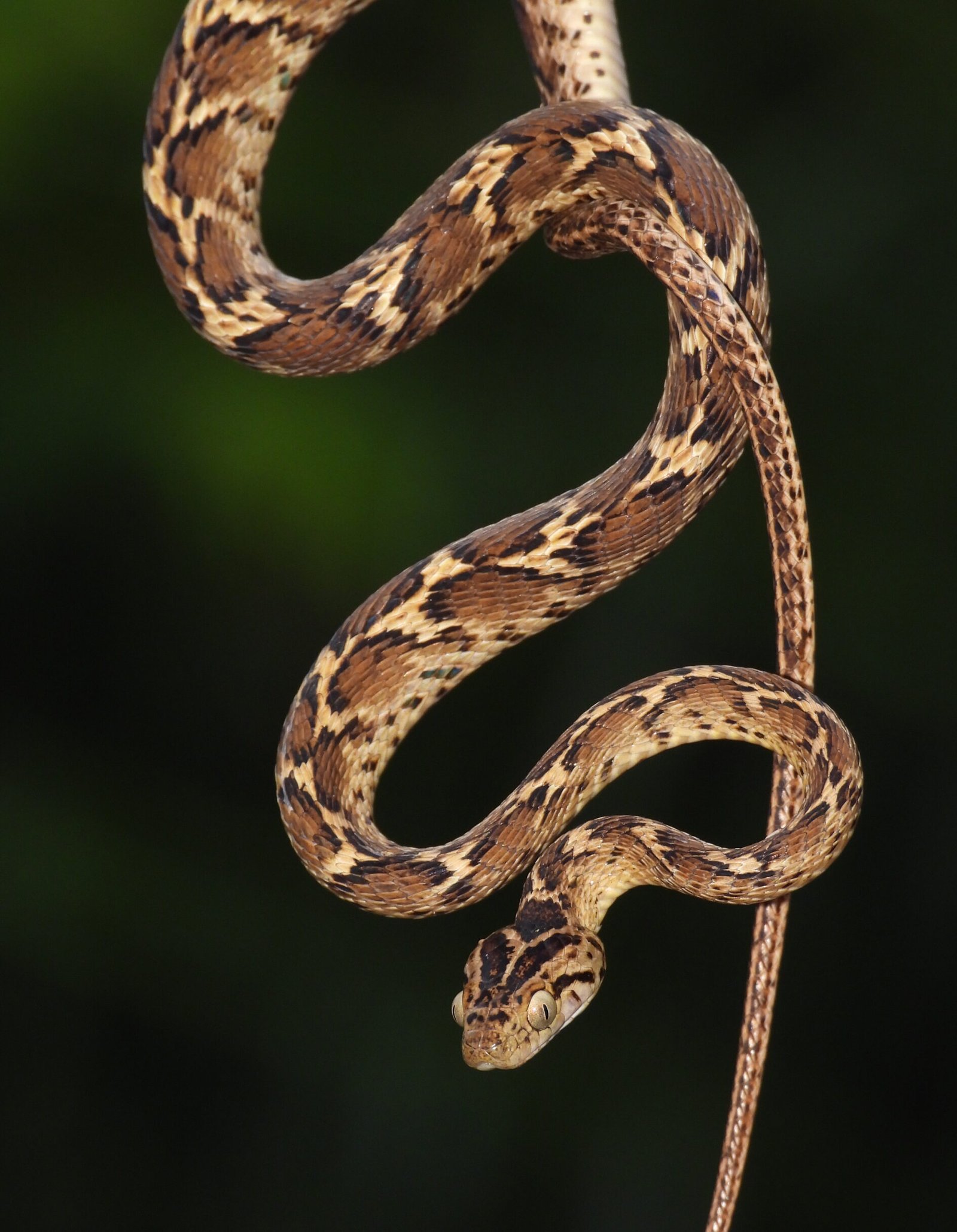
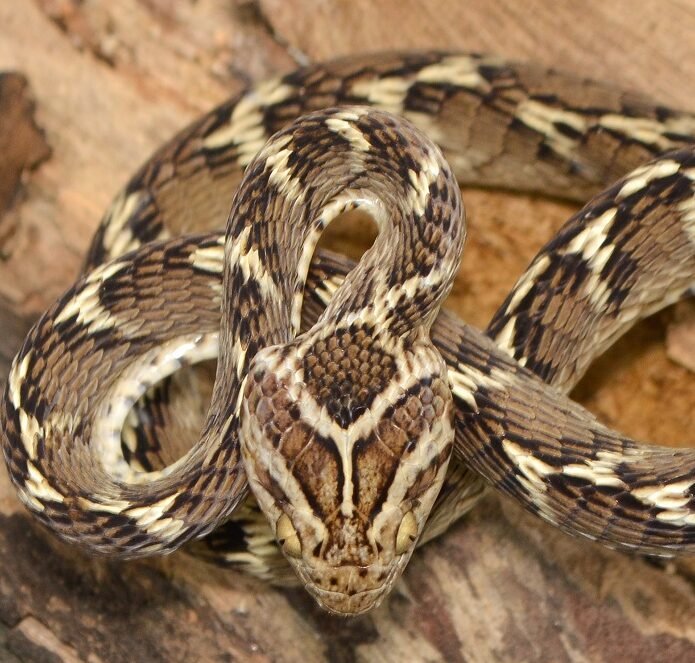
- Body colorRanges from yellowish-olive, pale grey, grey-brown, to light brown or tan.
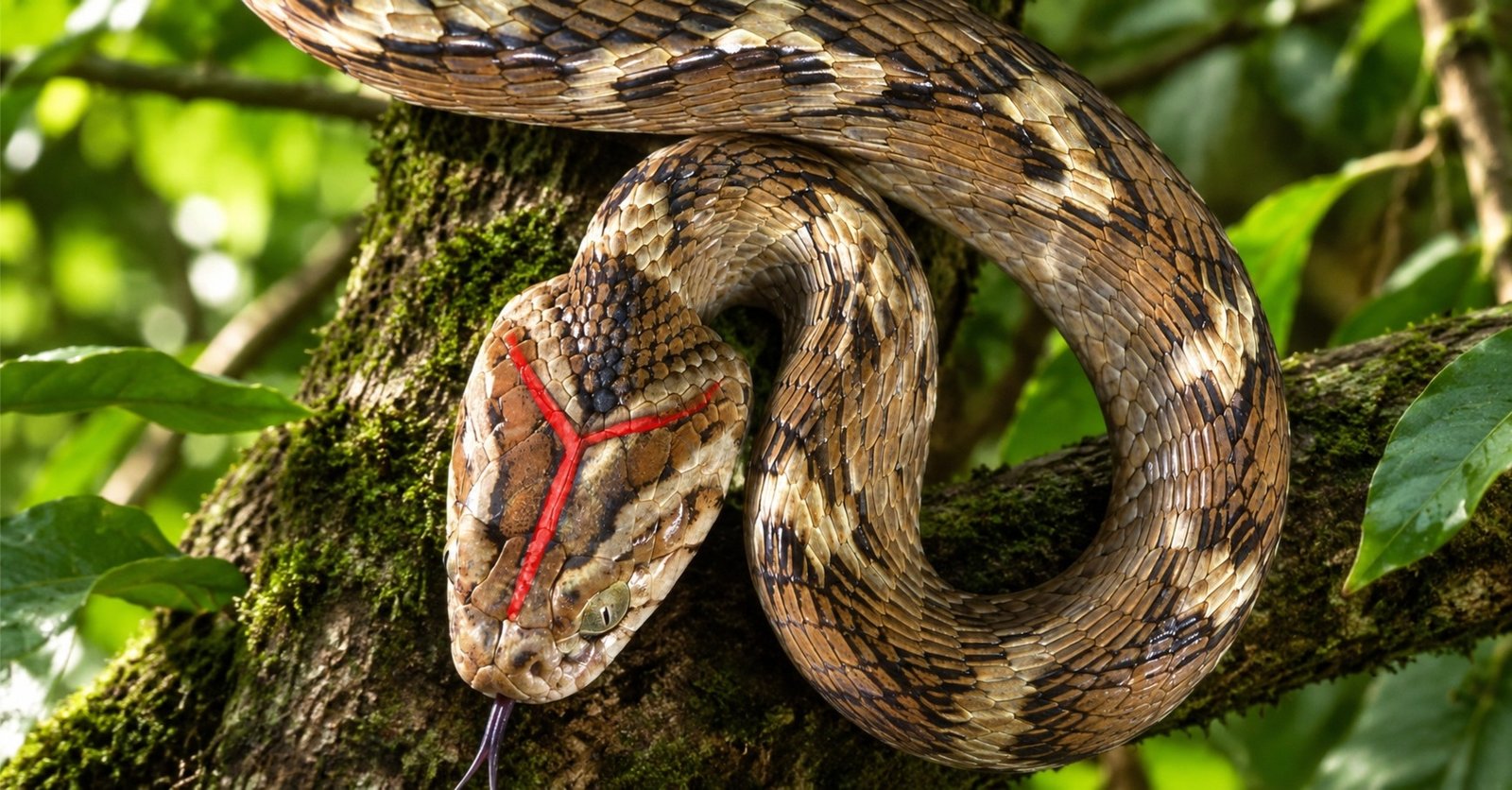
- Head shapelarge, triangular-shaped head
- Scale patternsmooth, obliquely arranged dorsal scales in 21 (rarely 19) rows with apical pits, along with a distinctive dorsal and head pattern
- Eye characteristicslarge, prominent eyes with vertical elliptical pupils (resembling a cat's eye)
- Neck markingsdistinct neck and head transition
- Average lengthroughly 2.3 to 3 feet
- Tail characteristicslong, thin, and tapers to a fine point
- Distinctive markingsfeatures several distinct physical and facial markings
Identification Warning
Taxonomy
| Classification | Details |
|---|---|
| Kingdom | Animalia |
| Phylum | Chordata |
| Class | Reptilia |
| Order | Squamata |
| Family | Colubridae |
| Genus | Boiga |
| Species | Trigonata |
Physical Characteristics
Size
- Average length
- roughly 2.3 to 3 feet
- Maximum recorded
- Maximum Recorded Length: 125 cm to 130 cm (approx. 4.1 to 4.16 feet)
- Weight
- 221.3 grams
Appearance
- Body color
- Ranges from yellowish-olive, pale grey, grey-brown, to light brown or tan.
- Pattern
- White or lighter-colored zigzag, banded, or blotched markings edged with black or dark brown along the back
- Head
- large, triangular-shaped head
- Scales
- smooth, obliquely arranged dorsal scales in 21 (rarely 19) rows with apical pits, along with a distinctive dorsal and head pattern
- Eyes
- large, prominent eyes with vertical elliptical pupils (resembling a cat's eye)
- Tail
- long, thin, and tapers to a fine point
Sexual Dimorphism
- Male
- The Male Trait: Males typically have proportionally longer and thicker tails relative to their total snout-vent length,slimmer and lighter-bodied
- Female
- robust and heavier midbody,proportionally shorter tail
Habitat & Distribution
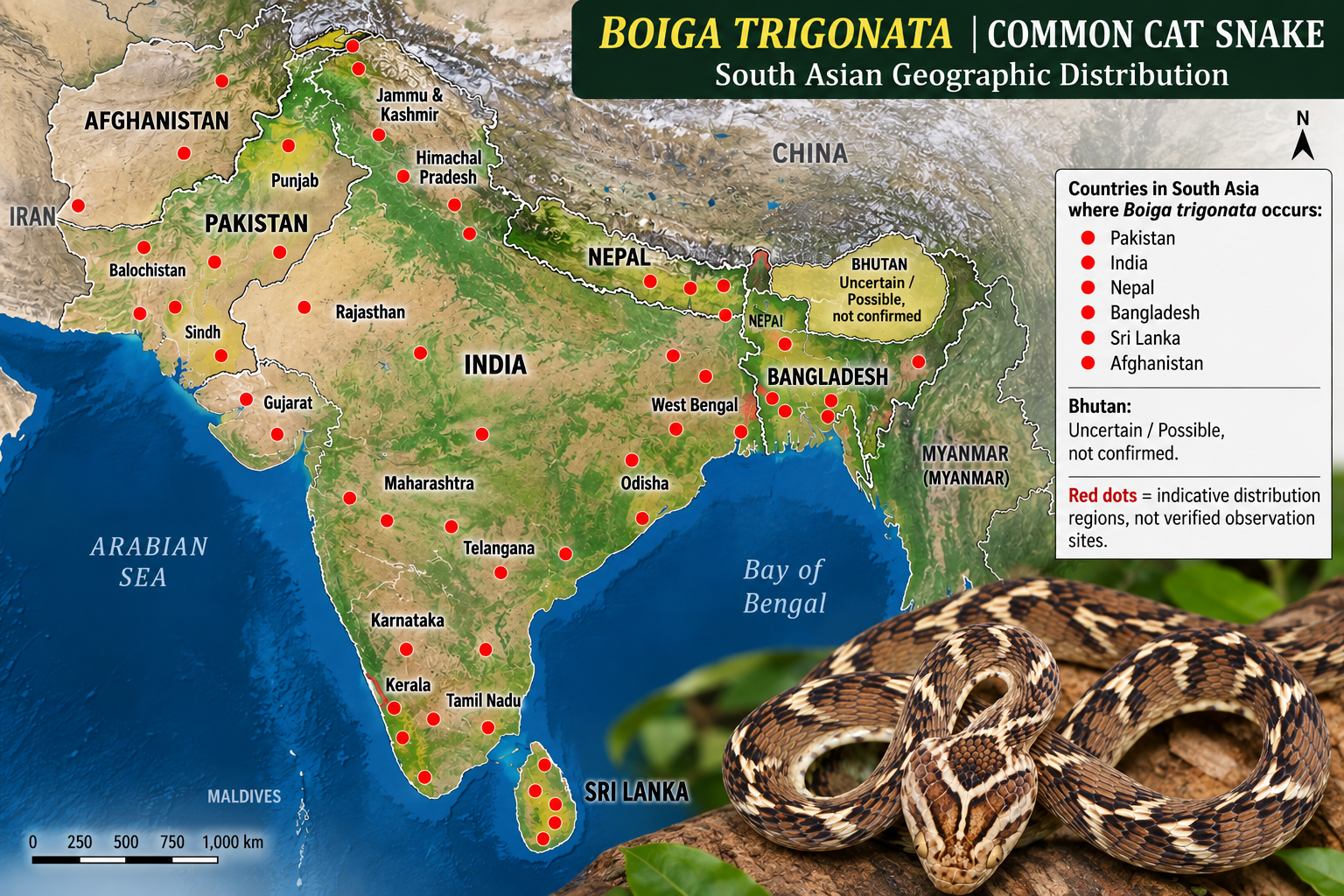
Geographic Distribution
- • India: Distributed widely across most of the country—including states like Gujarat, Maharashtra, Tamil Nadu, Karnataka, Rajasthan, Delhi, and West Bengal—except for the northeastern states past Sikkim and major offshore islands (such as the Andaman and Nicobar Islands).
- • Pakistan: Found broadly throughout the country, It occurs across western and southern border regions, including areas stretching from the Perso-Baluchistan frontier and Balochistan through various lower-elevation eco-zones and scrub or rocky habitats (such as northern/Dir areas and broader Indus Valley/plain gradients.
- • Sri Lanka: Present across the island nation.
- • Nepal: Found in suitable lowland and lower-elevation habitats.
- • Bangladesh: Recorded in mainland regions.
- • Afghanistan: Documented in western/southern sectors along frontier zones.
- • Iran: Found in eastern and southern territories.
- • Central Asia: Extends into southern Turkmenistan, southern Uzbekistan, and southeastern Tajikistan
Habitat
- Mountains
- Forest
- Grassland
- Agricultural land
Elevation: 1,420 meters
Behavior
Defensive Behavior
‘S’-Shaped Strike Pose: The snake coils tightly into a spring-like or classic ‘S’ shape, raising the front part of its body off the ground to signal readiness to strike.
Hunting Behavior
It relies on low-light adaptations, stealth, and a specialized venom delivery system to target prey in bushes, trees, and occasionally on the ground
Seasonal Behavior
It is strictly nocturnal year-round, spending daylight hours hidden safely in tree hollows, rock crevices, loose bark, or low dense vegetation.
Hibernation / Brumation
Central Asian / North Indian Populations: Snakes from areas like Pakistan, Turkmenistan, or Northern India face true winters and undergo distinct brumation cycles.
Reproduction
Reproductive Overview
- Reproductive method
- Oviparous (egg-laying)
- Mating season
- Pairs typically mate in the early summer months. Following successful mating, the gestation period leads into the peak monsoon season
- Clutch / litter size
- 3 to 10 leathery eggs
- Incubation period
- 48-70 days
Breeding Behavior
Once a male locates a receptive female, he initiates physical contact, aligning his body and wrapping around her dorsum to facilitate internal fertilization
Juvenile Characteristics
Hatchlings are very tiny and slender—frequently noted by wildlife rescuers as being smaller than a coin when first born—with a thin, laterally flattened body and a long, tapering tail
Human Interaction & Safety
If Encountered
- Keep a safe distance.
- Do not attempt to catch or kill the snake.
- Keep children and pets away.
- Contact a trained local wildlife / snake-rescue service where available.
- Boiga trigonata (Common Cat Snake) is a rear-fanged venomous species of low medical significance to humans. Bites generally produce mild local effects, including pain, swelling (edema), redness (erythema), and occasionally purplish discoloration (purpura). Posterior fang punctures may not be clearly visible. Prolonged biting or chewing may increase venom delivery and local tissue reactions. The species may be confused with the medically important Saw-scaled Viper (Echis carinatus), making accurate identification essential. Severe systemic envenomation, paralysis, and fatalities have not been reliably documented for B. trigonata. No species-specific antivenom is available, and clinical management is generally supportive.
Similar Species
| Species | Difference |
|---|---|
| Frequently Confused Non-Genetically Similar Species | |
| Echis carinatus (Saw-scaled Viper) |
Conservation
IUCN Status
Least Concern (LC)Population Trend
Stable (Least Concern)
Main Threats
- Habitat loss
- Human persecution
- Climate change
Conservation Programs
AI Overview
The Common Cat Snake (Boiga trigonata), also known as the Indian Gamma Snake, does not currently have any species-specific or dedicated conservation programs. This is primarily because it is listed as Least Concern (LC) on the IUCN Red List with stable populations across its vast native range in South and Central Asia.
Legal Protection
Country-Specific Legal Protections
Because international restrictions are absent, the legal status of Boiga trigonata depends heavily on the national wildlife laws within its native South Asian range:
Country / Region Legal Protection Status Relevant Legislation
India Protected Under the India Biodiversity Portal documentation, it is granted protection under Schedule 4 of the Wildlife Protection Act (1972). This makes hunting, capturing, or unauthorized possession illegal.
Sri Lanka Protected Classified locally as Least Concern (LC) but legally designated as a protected species under the Flora and Fauna Protection Ordinance (FFPO).
Nepal Indirectly Protected Classified as Least Concern (LC). While it may not always have standalone strict protection nationwide, populations residing within designated boundaries like Parsa National Park receive full habitat and wildlife protection.
Other Range States (Pakistan, Bangladesh, etc.) General Wildlife Protections Protection falls under regional or national baseline environmental laws that broadly regulate the hunting and capturing of native reptiles.